
Why every task you automate now buys back capacity
The Problem is Volume
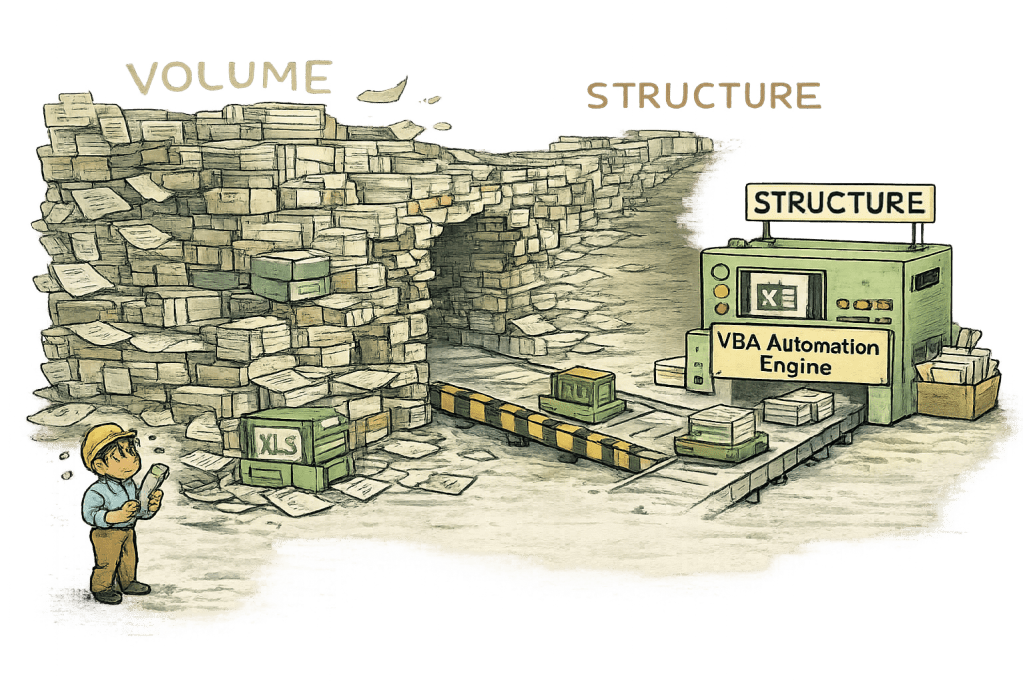
The problem is volume. Tax operations do not suffer from a shortage of time. Time passes at the same rate it always has. But what’s changed is the volume; the volume of work that has to be accomplished in the same amount of time.
You hear it everywhere:
“I can’t get all of it done.”
“I have to prioritize and focus only on what’s most important.”
“There’s too much to do, too little time.”
More entities. More filings. More data sources. More reconciliations, more documentation, more things to review, more edge cases, more analysis, more change layered on top of work that was already heavy. The pressure people feel as a “time problem” is really volume overwhelming the fixed number of hours in a day.
And this trend will not change, especially now, when technology makes generating new information as easy as uttering the words, “Let there be documentation!”
So how can we continue to operate in an environment like this?
The immediate answer is “risk-based decision making.” But in practice, that’s a euphemism for “selective noncompliance”. Normally, risk-based decisions are justified when there’s incomplete information and real probabilities to weigh. Strategies will have blind spots but must proceed anyway.
Selective noncompliance is not a healthy way to operate your organization’s compliance.
In the tax department, risk-based decision making isn’t normally forced by incomplete information; it’s forced by having too much to do in the available amount of time. To get through the volume, you must be selectively noncompliant in those areas where you think you have the least chance of triggering a costly exposure.
That’s the quiet part said out loud: selective noncompliance. This is not a healthy operational framework for a function where a core deliverable is, in fact, compliance.
Volume is the enemy, not effort.
Tax professionals are not slow, nor are they inefficient, nor are they resistant to change. But as a profession, we’re asked to wear too many hats at once and treat them all as equally important.
The newest hat is “transformation.” On top of all the volume and complexity you’re already managing, you’re tasked with transforming yourself and your department’s workflows. Who has time for that? Wrong question. Properly phrased: How do we make time for this?
If volume is the enemy, then automating volume is how we make time.
It’s a mistake to think automation only counts when it looks like “the future.” Putting off today’s automation for next year’s promised agent orchestration, or some end-to-end intelligence, devalues the work that actually removes volume now and continues to remove that volume in the future.
Excel automation removes volume immediately.
Why Excel Automation Still Does the Real Work
Excel remains where tax operations actually execute. I’ve previously described tax workflows as a factory floor: the Excel workbooks are the machines, and the end-to-end processes string those machines together. Inputs go in, they’re transformed, and the outputs are shuttled off to another machine.
All automation happens at the level of code.
When you’re automating in that environment, it’s traditional automation that is foundational. Actual automation happens at the level of code for so much of these workflows, and since we all operate on an Excel foundation, that code is VBA.
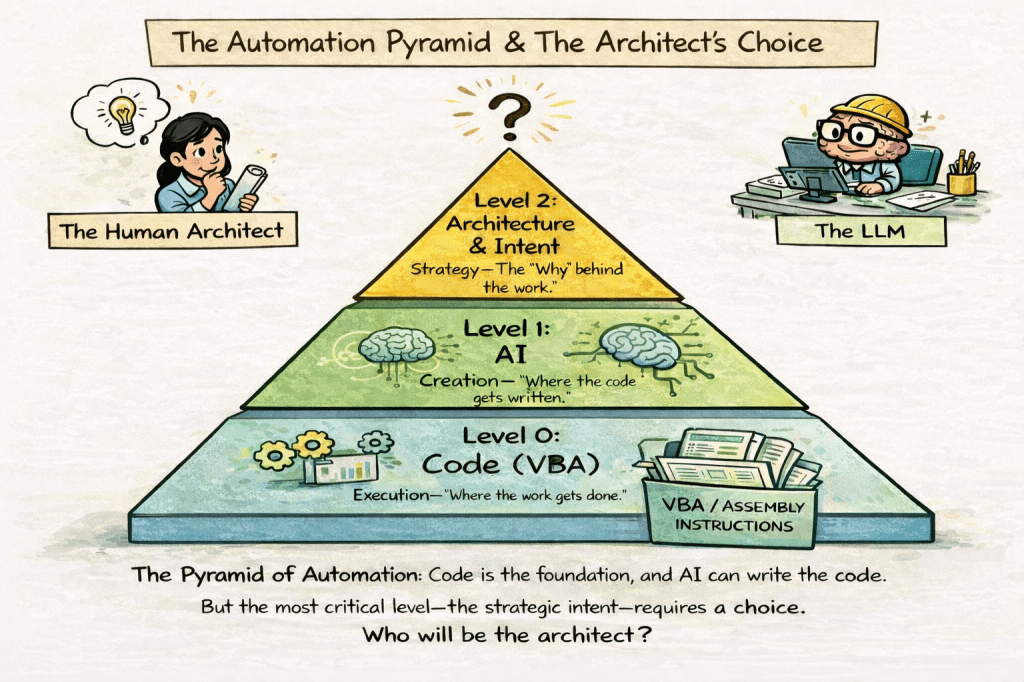
Traditional automation inside this environment does something very specific and very powerful: it converts repeated mechanical action into deterministic execution. A workbook can ingest data, apply mappings, run checks, and produce outputs. The workbook isn’t affected by the post-lunch coma at 2 p.m. It doesn’t forget steps. It doesn’t need to relearn the process each quarter. All of that, automated.
That’s what actually gives people time back, not the selective noncompliance. Remove the volume from the professional and place it onto the machine.
The Shelf Life Question
“But agents will soon provide relief.” It’s a reasonable objection. In 2026, agents are quickly becoming functionally useful, even if not yet mainstream nor fully economical.
So is it worth building automation now if the tooling landscape is guaranteed to change? Why invest in something with a finite shelf life?
Because the value accrues immediately.
When an automation runs, it starts paying off in time saved, errors avoided, and space freed up for the work that actually demands your judgment. If it delivers for two or three years, the return has long exceeded the investment. Plus we all know that processes persist longer than we originally expect.
More importantly, well-built automations also don’t just vanish when agents roll out. They leave behind structure.
Automations encode how work happens. Building one forces clarity by requiring you to identify the data that matters, define the outputs people rely on, and distinguish essential checks from habitual ones. Building automations forces a division between steps needing professional judgment, and those ready for the machine.
That structure is exactly what agents need.
Agents, like new team members, don’t conjure operational clarity from thin air. They inherit what exists. They learn from whatever ‘surfaces’ you create today, the boundaries you define, and the processes you’ve already made trustworthy.
Trust. It’s what you get when a process delivers complete and accurate results every time. Completeness, accuracy, and existence. The three assertions you must get right for any operational tax workflow to be efficient, reliable, and defensible.
So even if an automation is eventually superseded, it wasn’t wasted.
It becomes instruction.
It becomes the precedent.
It’s the first map of the “terrain” that future systems (human or agents) will traverse, not a detour on the road to “AI automation”.
Building for Continuity
Whether you realize it or not, you’ve arrived at a crossroads. You can wait for ideal tools, perfect data, and enterprise-wide readiness. Or you can begin laying rails now, using techniques that remove volume immediately inside the environment where the work already lives.
Waiting feels prudent. It sounds forward-looking, after all, you know the future includes more change and transformation, and you don’t know what that will look like.
In practice, waiting only guarantees one thing: more volume carried by humans, for longer than necessary.
Don’t be an actor in Waiting for Godot*. The cavalry isn’t coming even if some large enterprise sells you an agentic AI platform, and even then it needs wiring into your workflows. If the code isn’t there, there’s no agent that can reliably roll-forward the workbook.
Building now is what creates continuity. The person who understands tax operations through experience is the person best positioned to build the solutions.
Each automation reduces the surface area of work that requires human execution. Every reduction frees up attention for work where your expertise provides real economic value, or can be spent on improving the system itself.
If this sounds like an argument to replace your job, it isn’t. Frankly, people shouldn’t be spending their careers clicking buttons, shuffling data, or imitating robots in an Excel-based environment. We are meant for more than that.
Incremental, iterative change is how transformation actually happens in real operations. You have to get used to building the airplane while it’s already in the air, because that’s the normal, not the exception.
Automation of your Excel-based workflows is not a rejection of the promised future. It’s how you reach it without burning out the people who are supposed to lead the way.
Reclaiming Capacity, One Step at a Time
It’s a mistake to hold off on automating what you already know is repeatable, just because the perfect tools aren’t here, or because you don’t have hours to spare for the latest transformation project, or don’t know where to start.
No one gets both limitless time and a blank check for change. That’s why even small, well-targeted automation efforts offer quick returns. Each step reduces the burden and gradually wins back the attention you need for judgment, insight, and genuine value.
Fortunately, you don’t have to do this alone. Learning a new suite of skills under time pressure is daunting. Some teams have a champion who can lead the charge; many don’t. In those cases, bringing in someone who understands tax operations at the ground level, and who can engineer automation inside the environment where the work actually lives, can accelerate progress significantly.
That is the work I do.
If your team has its own champion, let them lead. But if you want help, someone who knows tax and can build solutions with you where the real work happens, I’m here.
Whether you reclaim that space with your own hands, a teammate’s, or an outside partner, the important thing is to begin.
___
* Waiting for Godot is a play by Samuel Beckett in which two characters wait endlessly for a man named Godot, who never arrives. The title has become shorthand for passive expectation replacing action, and for progress indefinitely deferred.

