
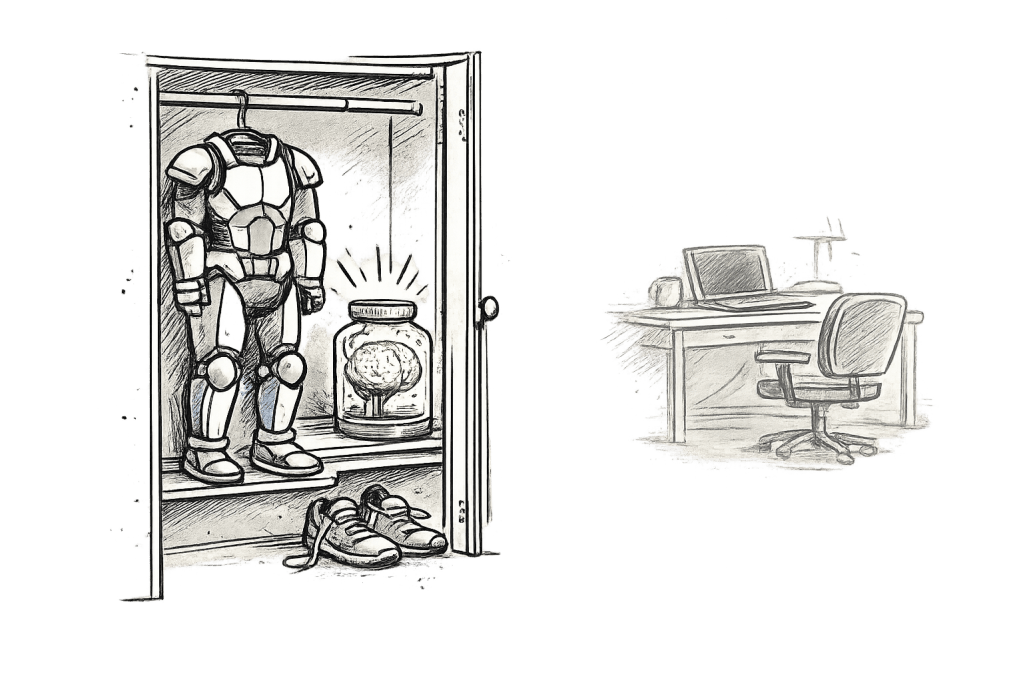
Play along with a classic thought experiment.
If you could have any superpower, what would you pick? And I mean a practical one, not pyrokinesis or telepathy, something you could actually use in the real world without getting yourself arrested or committed. To make it easier, I’m going to hand you super speed. Not as an innate augmentation of fast-twitch muscle fibers, but a much more practical suit. An exoskeleton you can buy. A few thousand dollars, largely accessible, and when you’re wearing it, your movements amplify ten to fifteen times. A full sprint could be somewhere between 250 and 400 kilometers per hour, results depending on the person.
You’ve bought it. It’s in your closet. Now what?
Two questions arrive almost immediately, and they feel similar enough that most people treat them as one.
How do I use it?
And where do I put it to use?
The difference between those two questions is actually enormous.
Getting Comfortable and Applying Your Superpower
“How do I use it” is about learning the tool. You’d need an airstrip to find your top speed. You’d need a track to learn how fast you can corner because you will fly straight into a fence trying to make a hard left at 250 km/hr. Your brain has a ceiling too, it turns out. Processing the world at 100 km/hr is its own acquired skill. You’d have to work your way up to the suit before you could really trust it.
“Where do I put it to use” is the harder question, and you don’t realize how hard until you’re standing there.
Let’s think about the morning commute. But our roads aren’t built for 200 km/hr of foot traffic, so you’re on the shoulder, half-protected, ripping past cars while people stare. Maybe a quick grocery run, but that faces the same constraints. How about mowing the lawn, cleaning the kitchen. And then you break a couple of dishes because your kitchen was never laid out for someone moving that fast through it, and you realize that before you can really use the suit at home, you’d have to redesign the space around it. Slower gains than advertised.
Then the harder version of the question: where does the suit produce economic value?
I found this genuinely difficult to answer. You could become a courier in a dense enough city. In a previous career, I was a journeyman hardwood floor installer doing piecework for $2.00 sq ft. This suit could work where payment is tied to physical throughput as long as your tools (and your brain) can keep up. You might wrangle a sponsorship if you’re the kind of person who’s comfortable doing 300 kilometer per hour stunts for a camera crew. But for most people, in most occupations, the honest answer is: the world wasn’t organized around a speed deficit. Handing someone the ability to move fifteen times faster doesn’t automatically connect to a problem that was waiting to be solved.
And this is where the analogy stops being about the suit.
Intelligence Superpower
The actual superpower being handed out right now isn’t speed. It’s intelligence. And the suit maps almost perfectly onto AI except inverted. Where the speed suit would affect physical work and leave knowledge work untouched, AI is doing the opposite. It’s amplifying the work done with your mind, in the same way the suit would amplify your legs.
The same two questions follow.
You hear the macro version everywhere: why isn’t AI showing up in productivity numbers yet, why is adoption slower than expected, why haven’t we seen the economic returns the headlines promised. Those are fair questions. But they’re easy big-picture observations, coming from a distance without having to answer those questions personally.
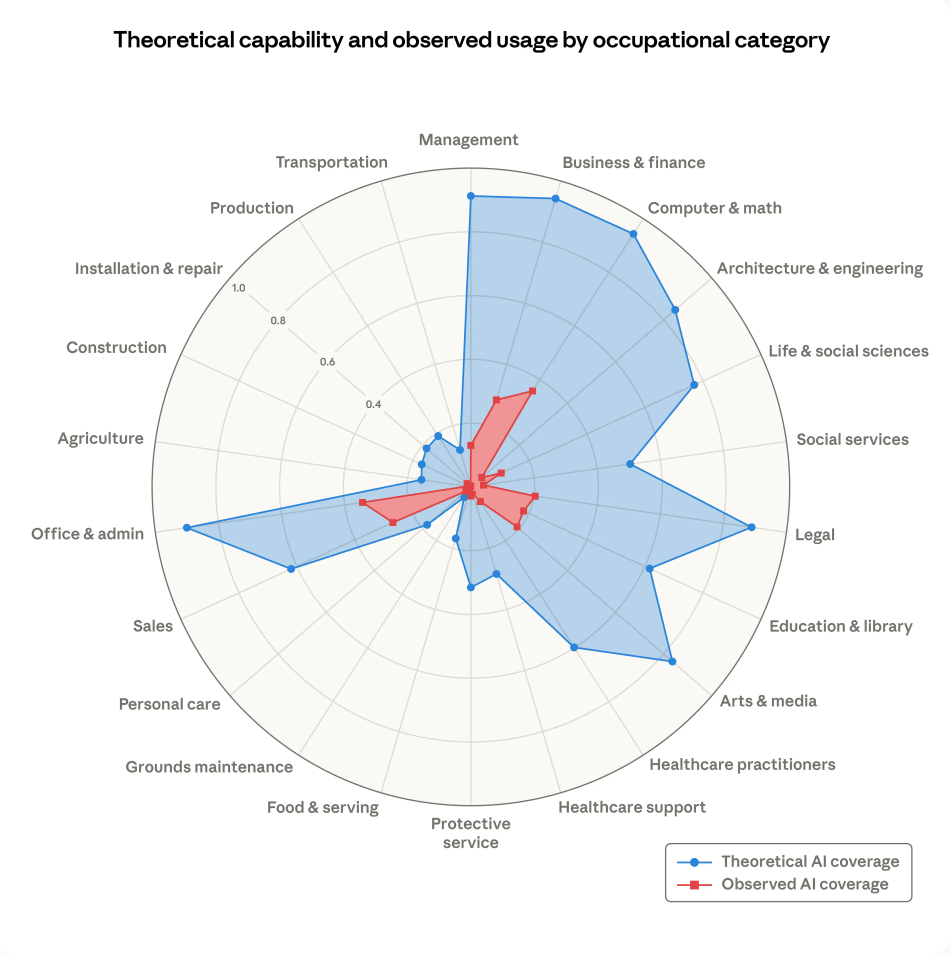
(Note the gap between actual use and theoretical use in Finance)
The personal version is harder: “what problem do I actually have, where intelligence is genuinely what’s been missing?”
I sat with the speed suit question earnestly and came up short. Not for lack of creativity, but because the problem the suit solves, needing to move faster, just wasn’t on my list in any economically meaningful way. The capability was real. The application wasn’t obvious.
That same experience is playing out for a lot of people handed access to AI and told to transform. The mandate is real. The pressure behind it is real. But the mandate doesn’t answer the two questions. It just adds a third one, the uncomfortable “why haven’t you done it yet?” one.
I think a big part of the honest answer is this: the problem that AI can solve might not be the problem you actually face and need solved. Although AI is very capable, most of us haven’t yet identified where intelligence, not speed, not more hours, not more headcount, is genuinely the missing piece.
It’s a harder problem than it looks. And it’s worth sitting with, rather than papering over with another tool subscription.

