

The Beautiful Lie
“You can just do things now… with AI.”
We say that like it’s a punchline, or a revelation. The truth is, there’s both promise and peril packed into that sentence. AI has made it possible for ordinary people to try out things that used to be technically, economically, or psychologically out of reach. That’s something to celebrate.
But also let’s not pretend this is entirely new. You’ve always been able to “just do” things. The idea of agency, of choosing to try something and see where it takes you, existed long before prompts and large language models.
The difference was before, you had to slog through the beginner stages. You had to wrestle with the friction and you had to spend time, take classes, ask dumb questions, make dumb mistakes, and get good the slow way.
That’s what AI has changed. Not the “can I try this?” part, but the timeline. Today, the right series of prompts can move you from total novice to functional advanced beginner in a few hours. You can now jump the hardest part – the part where most people stall out or give up. You get the dopamine of progress before having to pay the full price of learning.
This opens up a world of possibilities.
And… it’s also a potential trap.
We’ll get to that. But first, let’s define where AI drops us off when it gives us this magical boost.
The Vaporized Knowledge Barrier
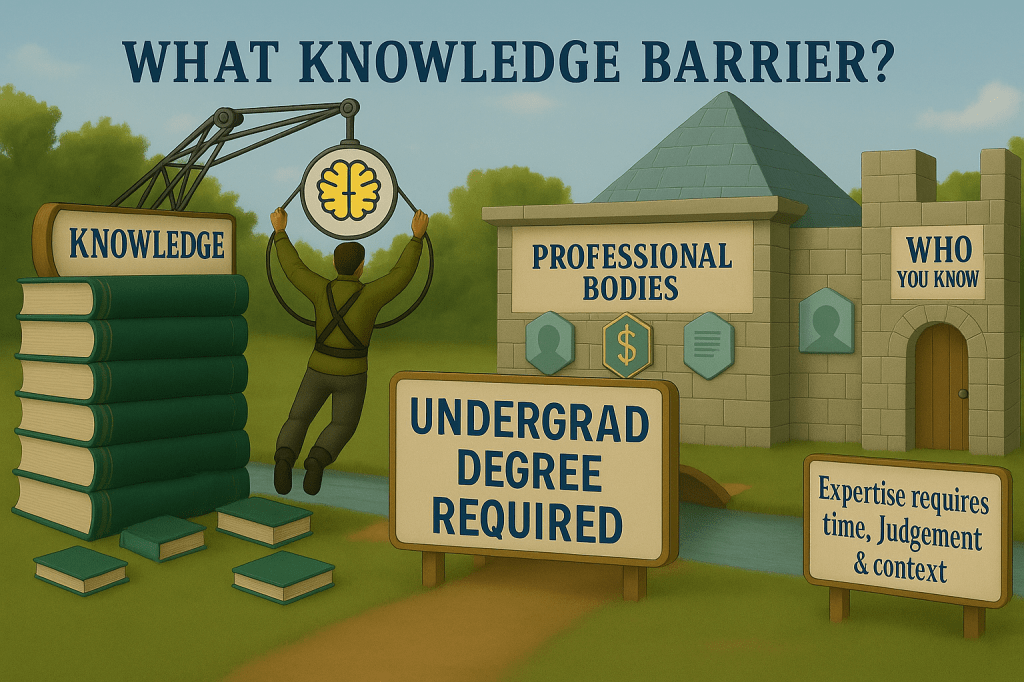
Before the artificial accelerants, if you wanted to break into a profession, say tax, design, programming, therapy etc., you had a wall to climb.
That wall was knowledge and it came with a price tag and a timeline.
A four-year degree.
Maybe a couple more for your master’s.
And depending on your field, five to ten years of post-formal, real-world exposure just to feel competent.
The knowledge barrier to entry made you earn it before letting you operate. That wasn’t always a good thing. But it was the thing.
Now? That wall has been… vaporized.
Though existing institutions and professionals are slow to recognize this, clinging to “but it hallucinates” as an excuse. The projected leaps in 2026 and 2027 capabilities will be decades of progress shortened into a year. You must know this will happen. More barriers will fall.
We largely treat the models like a vending machine, insert your prompt tokens and it will deliver you an answer. You might rewrite it using your voice and use plain language. You generate scenarios. You get answers back that are fluid, confident-sounding, and well-formatted. You don’t need to memorize anymore. You don’t even need to be particularly efficient at finding information. It is presented to you.
You used to pay your dues before having access.
Now you get access instantly – and you haven’t even paid attention yet.
When you realize how easily the machine lifts you over that wall, it’ll be easy to forget the wall was ever there in the first place. Of course, that shift doesn’t come without implications. Because when the barrier disappears, you land in the middle of a game you might not actually know how to play.
And that’s where we enter the territory of The Pyramid of Expertise — and the strange danger of becoming a confident beginner too soon.
The Pyramid of Expertise: Where AI Drops You
In 1980, Stuart and Hubert Dreyfus proposed a five-stage model describing how humans acquire skills through experience and decision-making. It’s still one of the most intuitive frameworks for understanding expertise — and it turns out to be especially useful for describing what happens when someone starts using AI for the first time.
Let’s recap the stages:
The Five Stages of Skill Acquisition (Dreyfus Model)
| Stage | Description |
| 1. Beginner | Follows strict rules. Needs context-free instructions. Easily overwhelmed. |
| 2. Advanced Beginner | Starts to recognize patterns and context. Can make small independent decisions. |
| 3. Competent | Sets goals, makes plans. Begins to recognize the consequences of decisions. Capacity to tolerate complexity through planning. |
| 4. Proficient | Sees situations holistically. Pattern based intuition roots in lived experience. Self-corrects on the fly. |
| 5. Expert | Operates almost instinctively. Deep knowing cannot easily be verbalized and that choices flow naturally without conscious rule-checking |
I worked my way up one rung at a time, shaping my professional identity. Those initial years are meaningless now, just a memory of how things were done pre-AI.
AI skips that first rung for you.

Sit with that a moment: Most people using AI today are not starting at “beginner.” They’re being airlifted straight to advanced beginner — often in mere hours.
That’s remarkable progress. But it comes with a risk…
The Advanced Beginner Trap
Reaching the second step on the ladder instantly is thrilling. It feels like progress. And in a way, it is. But it also creates a unique kind of disorientation that professionals and educators have seen for decades, just not at this speed or scale.
Here’s the risk:
You feel fluent — but you’re still fragile.
You can recite — but you’re not yet reliable.
You can “do” — but you don’t yet understand.
It’s not unlike what my father used to call “third-year university mentality”: that fleeting moment when you know just enough to stop listening, yet not nearly enough to grasp the bigger arc of competence. I hated the phrase in my 3rd year although years later I understood exactly what he meant.
It’s a phase marked by:
- Overconfidence without depth
- Performance without grounding
- Output without synthesis
- Sharing without deeper understanding
And in the AI age where “you can just do things”, be mindful of your position on the pyramid of expertise.
Advanced beginner with AI ≠ expert with experience.
Nevertheless, we must reinvent ourselves in new ways and step into new and unfamiliar areas, and do so fast. This is a matter of professional survival not merely to cope with the volume and complexity, but to avoid being rendered obsolete – either overshadowed by an AI-augmented peer, or worse, replaced with an AI agent. Skipping the first rung on the ladder is a necessary head start.
Don’t Compete with AI on Knowledge Alone
Let’s be blunt: if your value in a domain is rooted entirely in knowing things, you are now in direct competition with a machine that will soon ‘know’ those things better, faster, and (eventually) with fewer hallucinations.
Today, some professionals are already handing associate-level tasks to AI. In two years? More partners, managers, senior practitioners in industries like tax, law, accounting, and knowledge consulting will be leaning on agentic AI for review, research, prep, and synthesis, not just entry-level assistance.
So the real question becomes:
What value do you bring when knowledge alone is no longer scarce?
Here’s a re-framing professionals need to internalize—fast:
| 🚫 Don’t Compete On… | ✅ Compete Here Instead |
| Memorization of technical facts | Application in context to real decisions |
| Rule-following & framework use | Framing ambiguity, contextual adaptation |
| Static domain expertise | Cross-disciplinary synthesis and connection |
| Explaining processes | Translating relevance & risk to a business audience |
| Output volume | Taste, judgment, and prioritization under pressure |
| Having answers fast | Asking better questions and sense-checking intuition |
AI is exceptionally good at producing output that sounds convincing. But not everything that sounds right is right for the moment, the organization, or the user. That still requires common sense, discretion, and context judgment; a uniquely human compound of empathy, risk awareness, and experience.
This is where professionals still hold the advantage:
- In knowing which 5% of output actually matters
- In translating complex insights into narrative
- In recognizing that how something is said often changes what it means
Your future self must be building human layers on top of automated competence: layers like relevance, story, perspective, and trust.
And in domains like tax, the stakes are uniquely high. Because it’s never just about the rule, it’s about how it connects to business action, risk posture, and strategic outcomes. AI can summarize subtleties. But only you can anchor and apply them.
AI Is Already the Associate — Your Role Is Moving Upstream
It’s worth repeating that today in some firms, companies, and corporate teams, work that used to fall to early-career professionals is increasingly being routed through generative AI. This will only increase. If you’re still spending most of your time doing what the machine can already do passably, your career trajectory is stalling against its rising ceiling. The right move isn’t to resent the shift. It’s to move up the stack.
Quietly, a new norm is forming:
“Have the AI take a first pass.”
Initial research, technical memos, policy comparisons, pro/con scenarios, even some numerical analyses and calculations aren’t “clerk work” anymore. They’re increasingly “AI work”. The junior associate isn’t disappearing, but they will soon share the desk with a machine that never eats, never sleeps, and never forgets the ask.
And it’s going to scale. Agentic systems, AI tools that are more proactive, goal-directed, and integrated into business systems, are just starting to unfold across industries. They will get better. Fast. 2026 kind of fast.
So here’s the strategic question:
If the AI is the associate… what are you training to become?
Because doing tasks that an AI can do passably today is a temporary game. You may be faster or more precise (for now), but the ceiling is closing in. So the professional who wants to keep evolving has just one direction to go: upstream.
A shift in posture:
- From executing tasks → To shaping direction.
- From gathering data → To informing decisions
- From summarizing technical rules→ To delivering strategic clarity
- From providing the answers → To better framing of questions.
- From merely applying the rules → To steering the business wisely
- From explaining tax positions → To building trust through
business fluency
These are both conceptual and operational shifts. This repositioning is especially urgent in technical professions like tax and other domains where AI can operate fluently at the surface, but lacks the experience to operate in context. Difficult to achieve when deadlines loom and you’re the glue holding together fractured systems.
Create time yourself and find others who can help with this transformation.
The future belongs to professionals who don’t try to outperform the machine, but who train it, translate it, and think one level up.
What You Should Do Differently – Starting Now
Whether you’re early in your AI journey or already integrating it into your workflows, the real question to grapple with is about how you’ll position yourself in your role when the machine is a highly capable assistant, but you’re supposed to be the one steering the strategy.
You may feel the squishy recommendations below fail to meet the “I have messy data and hard deadlines” reality, but in the immediate years, you must re-calibrate your work.
Out-thinking Over Out-knowing
Don’t waste energy trying to out-memorize the machine. That game is over. The advantage now is in discernment: knowing what to ask, when to challenge, and how to shape partial answers into coherent, strategic frameworks.
Routine knowledge is being absorbed by the tools. Critical thinking is your move.
Fluency, Not Dependence
Treat AI like a colleague-in-training or AI co-worker. Use it daily. Ask tough questions. Interrogate outputs. Don’t just nod along. Develop an instinct for what it’s good at—and where it still fakes confidence without credibility. That’s not fear-of-AI. That’s honing your craft.
Compression is the Signal
AI produces more content than anyone will ever read, but compression, condensing complexity into clarity for your audience, is still a human differentiator. If you want the respect of decision-makers: say it simpler, faster, better. With fewer words and more consequence.
Live in the Connective Layer
The most valuable professionals aren’t always the deepest experts. They’re often the ones who synthesize across departments, domains, tools, verticals, and timelines, those who can align what’s possible with what’s meaningful. AI doesn’t know how your org actually works. You do.
Cultivate Taste
Taste is what makes one solution feel obvious and another feel clumsy. It’s hard to teach and harder to fake. But it can be trained, slowly, through exposure, iteration, and reflection. Taste is where real judgment lives. The machine doesn’t have it. You have it.
Narrate, Don’t Just Decide
In a machine-generated world, transparency increases in value. Clients, execs, and teams want to know why something was chosen, not just what was chosen. Start narrating your thought process. Privately, when reviewing; publicly, when leading. It builds trust and improves your own logic.
Understand the System
Think beyond tasks. Look at flows. Understand how your work connects to the operations around you—data, people, decision paths. Systems-thinking. If AI is eating the siloed work, your edge lives in the interconnectedness. Learn to spot the hidden seams.
Double Down on Being Human
What AI still can’t replicate: context, empathy, judgment, timing. Don’t hide the quirks that come with being human, your instincts, your point of view, your ability to sit with uncertainty. In fact, sharpen them. They’re not soft skills. They’re the hardest thing to replace.
The Meta-Skill: Agency in the AI Age
We’ve talked a lot about knowledge, speed, and skill.
But just beneath all of that is the real differentiator: agency. The belief that you can do something, frame something, fix something, start something, even when it’s new, unfamiliar, or hard. And in 2025, that’s what people are turning to AI to help them rediscover.
Look at the top 3 use cases for generative AI this year:
- Therapy / companionship
- Organizing my life
- Finding purpose

Not drafting contracts. Not tax memos. Not quarterly planning. Not a productivity tool (unless you code).
Those productivity gains are all downstream. Upstream, people are using AI to reconstruct a sense of movement, focus, and self-trust: the squishy stuff. They (we) are using genAI as a coach, mentor and therapist. Sure, it’s not perfect. It won’t save us from the global mental health crisis and it won’t make meaning magically appear. But it can help someone take the first step. And often, the first step is the hardest part of agency.
So let’s take the optimistic reading where AI doesn’t replace human motivation instead reignites it and reminds you how to move, then professionals, especially those with deep experience, are standing at the edge of a powerful pivot:
You’ve already put in the time building competence.
The next challenge is building and modeling agency.
The speed of change ahead of us has no historical precedent.
Agency becomes your most transferable asset.
Final Thoughts: Now That You Can, What Will You Build Toward?
Let’s come back to the phrase that started all this:
“You can just do things now… with AI.”
You can learn faster than ever.
You can build what was previously out of reach.
You can translate complexity, navigate ambiguity, and wield tools that would have seemed impossibly advanced just five years ago.
But the real challenge is embedded in that word “just.”
Because nothing is ever just doing. There is always risk, always intention, and always the cost of attention. And now that we’ve swept away the traditional barriers, education, access, even confidence, the harder work begins:
- Learning to do things well.
- Learning to pursue taste.
- Learning to use tools without becoming wholly dependent on them.
- Learning how to keep growing when the hardest steps are no longer obvious.
The ones who will thrive in our future world aren’t the ones with the crispiest prompts or the most polished outputs.
So yes, you can just do things with AI. The better question now is:
What will you do consistently enough, reflectively enough, humanly enough… that it might one day be done beautifully?
That’s still yours to answer.


One response to “You Can Just Do Things”
[…] We’ve all followed the path in panel A but now we have a technology that can make us good beginners at anything. […]
LikeLike