

Beyond the baby-gates.
Playing “would you rather” with my kids is painful. Questions toggle between the innocuous and the outrageous: would you rather eat only vegetables or only pizza for a full year. Or, would you rather have a bear bite your face or an alligator rip off your arm?
Every time I’m nudged to project myself into the hypothetical, tallying up costs and comforts. As odd as it sounds, that’s not such a bad parallel for how we confront the boundaries of our own capabilities: there’s always a choice, and rarely a clear path without discomfort.
Play along with me for this one:
would you want to augment your abilities and accomplish things previously out of reach, or would you prefer to stay more or less where you are while technology takes tasks off your plate?
Not exactly ready for the family game circuit, but read it again and sit with it for a few minutes.
Of course, this is a false dichotomy. Most of us want the benefits of both: the satisfaction of learning or improving, and the relief of delegation. If only there was some kind of futuristic technology that could let you genuinely enjoy both outcomes at the same time…
Fortunately such a magic box exists. And because of where its development currently stands, the magic box cannot do much on its own. That’s where the most potent applications of artificial intelligence come in: augmenting yourself.
Augmentation Before Automation: How Small Steps Become Giant Leaps
The seductive promise of artificial intelligence, that it might finally take work off our plates, is a half-truth that starts with what it might or should be able to do. Having work taken off our plates really matters in the real world where we’re all drowning in volume. But what actually happens, for nearly everyone who succeeds with these tools, is the opposite of magic: there’s a clumsy dance where you teach yourself and the machine how to work together. Not automation, but augmentation, at least at first.
Progress is much like learning to play an instrument; it’s slow and repetitive. You make changes one step at a time. Each step, however tedious, is less like fitting a new cog into an old mechanism and more like discovering an unexpected door to a room you never thought you could enter.
We’re unwittingly putting up baby-gates around our beliefs around what we can do; we don’t notice they’re there.
In fact, anything we do is bound by constraints; many are self imposed. We’ve unconsciously put up baby-gates all over our living room. The magic comes from realizing you can unlatch the gate; now you can do things you simply couldn’t do before.
It’s simultaneously uncomfortable and exhilarating.
Accelerate Excel
Consider our use of Excel. We all have the baseline skills and what we think is possible is bounded by our ability to hand-craft worksheets and workbooks. Every accountant worth their salt came up through the ranks and were forced to become handy with excel formulas. Management roles and above take on a different shape and excel skill is less valued, stopping that muscle from developing further. We’re unwittingly putting up baby-gates around our beliefs around what we can do; we don’t notice they’re there.
The first experience of asking AI for help generating a complex formula might feel like an impressive underwhelm because the ask is simple and the result is incremental. Yet, each time you succeed in streamlining action in a clunky old rollforward process, that small win ripples outward. The effect is cumulative: what began as an experiment soon leads you to wonder “what else can I update to be one-and-done, never-update-again, always-pulling-relevance, kinds of links?”
=LET(
yrs, ‘>Class 13’!$B:$B,
r, MATCH(1E+10, yrs),
IFERROR(INDEX(‘>Class 13’!$K:$K, r), “”)
)
The above isn’t something I could have come up with on my own. This replaces the manual approach of re-linking cells during the annual rollforward of an unstructured amortization table. Never again will that formula need to be touched. Small successes compound.
That part is exhilarating. The discomfort is that I’m now reliant on the tech to achieve the vision I have for the workbook…take the machine away, and I’m no more capable than I was 3 years ago. Spreadsheets won’t be going away anytime soon, fortunately for me, nor will AI (unless there’s a power outage, but frankly nearly all work shutters to a halt when the power goes out).
So I’ve convinced myself that it’s ok to develop some reliance. Over time, the concepts sink in even when the technical doesn’t. That’s key.
Exploring and teleporting
Consider the contrasts below.
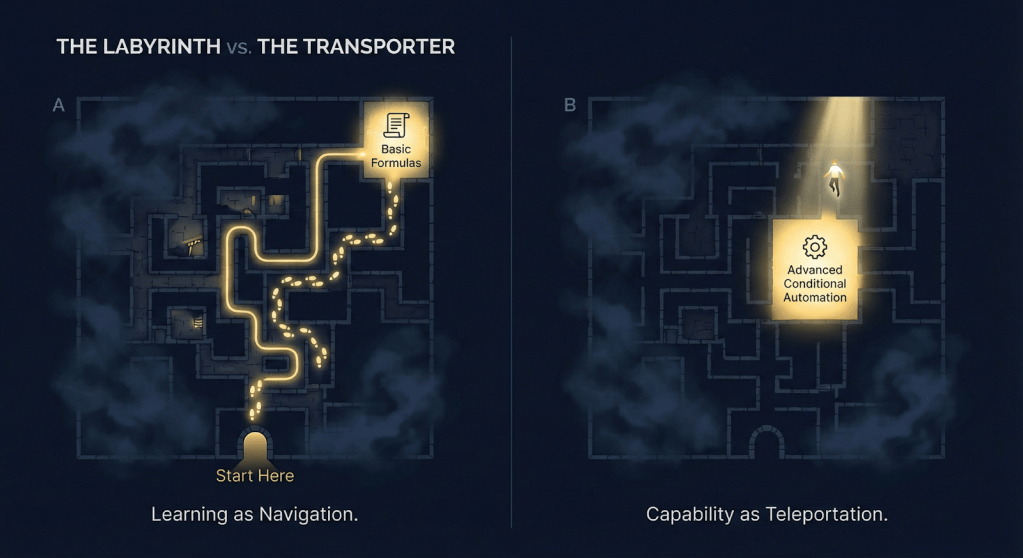
We’ve all followed the path in panel A but now we have a technology that can make us good beginners at anything.
This is where the mindset shifts and you must approach problems like a builder or explorer equipped with fresh tools. With each success, however minor, you expand the boundaries of what you consider possible in your own work.
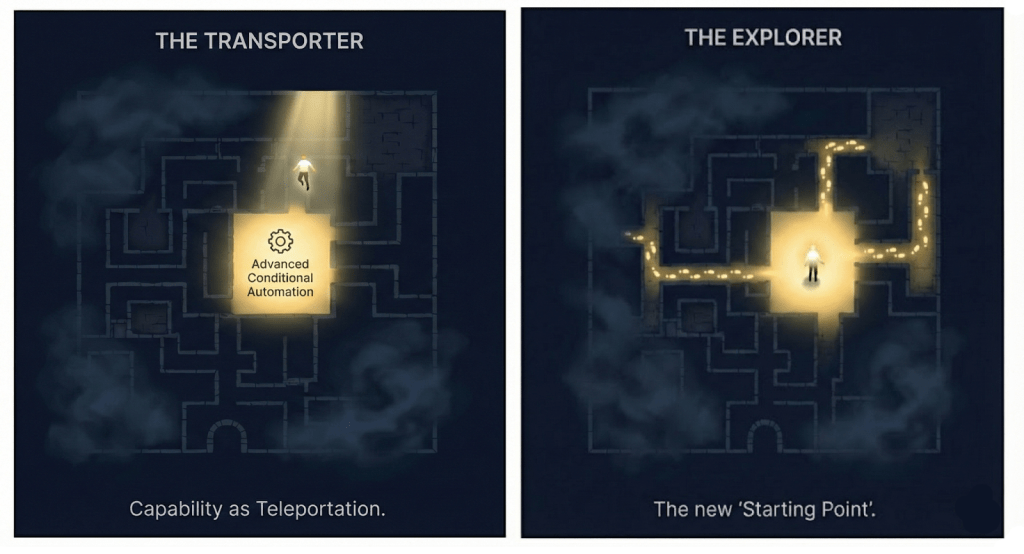
I’ve found that describing what you want, in coherence with a broader architecture, is the hardest part and its own learning curve; one I implore you to embrace.
When the Baby Gate Becomes a Springboard: The Allure (and Danger) of Delegating to AI in Writing
The flip side of augmentation is thoughtless delegation. If you want a lesson in what happens when low-effort delegation gets ahead of skill, spend a few minutes scrolling through LinkedIn. What you’ll find is a steady stream of posts written for the algorithm: identical writing formulas, motivational platitudes, the obligatory emoji parade, all ending in a call to action as if that might revive what just died on the page.
Style and voice, distinct, hard-won things, are lost the moment one thoughtlessly hands the whole process to a machine.
In today’s fast-paced digital realm, it’s not about doing more — it’s about doing what matters. Let’s explore the evolving tapestry of ideas shaping the future of leadership, innovation, and impact. This isn’t yesterday’s thinking — it’s a bold reimagining of what’s possible when technology and human potential align. It’s not about the tools, it’s about the transformation. By breaking silos, embracing synergy, and unlocking scalable value, organizations can navigate complexity with confidence and clarity. The future doesn’t belong to those who wait — it belongs to those who are ready to act. 🚀✨
I feel like I need to shower after reading that.
The flood of AI-generated content is not delivering a golden age of communication. Style and voice, distinct, hard-won things, are lost the moment one thoughtlessly hands the whole process to a machine. Delegation without direction yields generic output and kicking down the baby gate is no substitute for gently unlatching it.
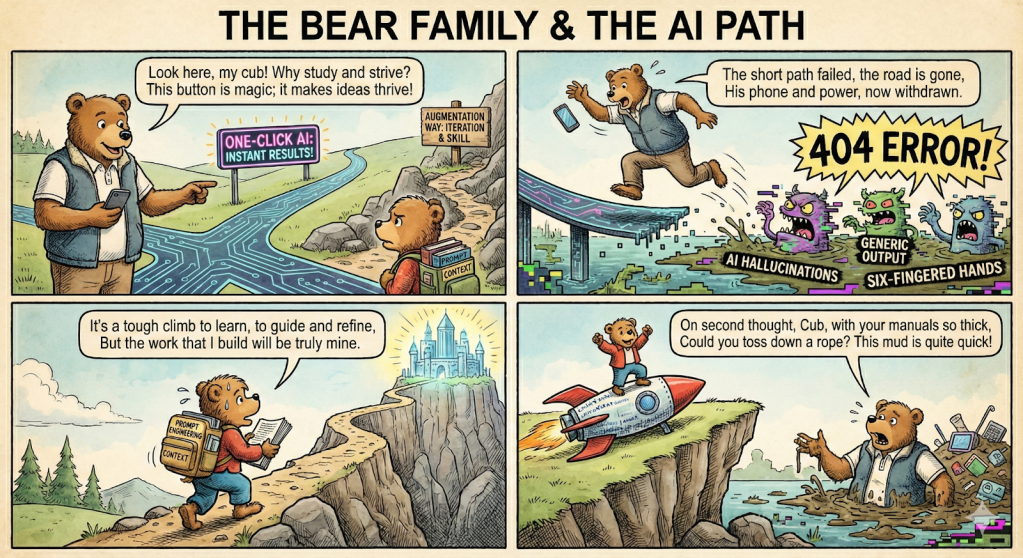
In a way it’s painful, in a way it’s perfect. Posting AI slop is the accidental admission of incapability and showcases what is lacking: substance. Best to admit this privately and try to improve by augmenting yourself!
What’s the difference
If we’re limited in both our technical excel and separately our writing skills and if both can be augmented by AI, then why does the former feel like real advancement and the latter like slop?
There is a clear difference.
I’m not outsourcing my thinking. I’m outsourcing the syntax.
When I ask the AI for a formula or VBA script, I’m not outsourcing my thinking. I’m outsourcing the syntax. I still own the logic, the goal, and the responsibility for validating that it works. The AI is a powerful, non-judgmental junior developer who types really fast. I have to perform the review. That review process, the friction of testing and revising (essentially giving the AI coaching notes), is what builds my own capability.
With writing, the temptation is different. When someone delegates a LinkedIn post, they are often trying to outsource the thinking itself. They want to bypass the hard work of forming an opinion, structuring an argument, and finding a unique voice. The syntax you get is the default to which the AI’s writing personality has been tuned and thus you get the same style blog with a thousand different titles.
For clarity:
- In Excel, you use AI to solve a technical execution problem within a strategic framework you already own.
- In writing, people too often use AI to solve a strategic thinking problem, hoping for a good technical execution as a byproduct.
The AI is much better at the former. It can give you excellent technical execution for a flawed or generic strategy. The public nature of writing just makes this failure mode painfully visible. We don’t see the thousands of mediocre-but-functional internal spreadsheets generated by AI, but we are drowning in the flood of identical public-facing posts. This is why AI feels like augmentation in one instance, and generic slop in the other.
Be the explorer
AI can put you in a new place, but it’s your moves after landing that put the power in your hands.
Teleporting to the middle of the labyrinth is only the beginning. To really make the new skill yours, you need to explore beyond the doorstep. In moments, you’ve arrived in a room where experts took years; but do not delude yourself that you’ve become peers. Continue testing boundaries, peering into the corridors, gradually illuminating the path surrounding your new location and you’ll get there. This is the difference between “borrowing” ability and “building” it. When you take time to experiment, revise, and learn how the new chamber connects to all the rooms you skipped, you start constructing a genuine mental map.
AI can put you in a new place, but it’s your moves after landing that puts the power in your hands. The real learning resumes the moment you put away the teleport key and start walking the corridors again.
So I ask again, would you want to augment your abilities and accomplish things previously out of reach, or would you prefer to stay more or less where you are while technology takes tasks off your plate?

