

The Transformation Has Begun
Three publications highlighting AI disruption landed in the span of six weeks earlier this year that caused a predictable reaction.
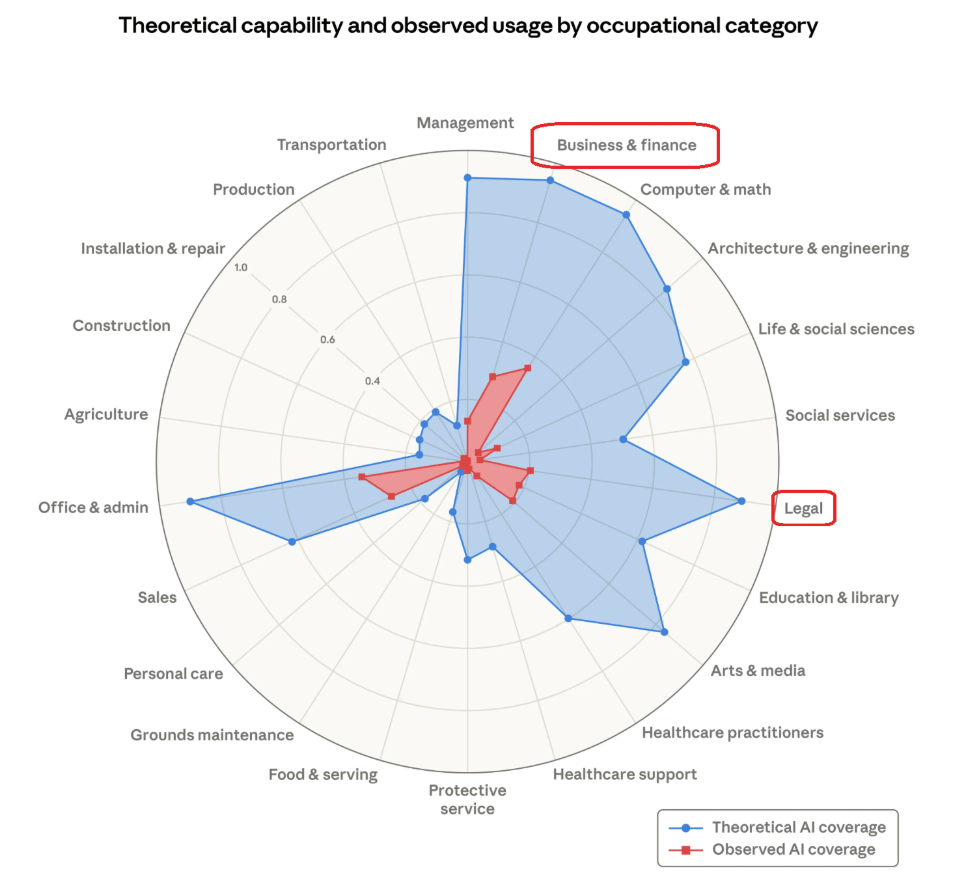
The first was Anthropic’s report on AI’s impact on the labour market, a deliberate contribution to a conversation Anthropic openly wants to accelerate. The report introduced a radar chart mapping the gap between what AI could theoretically perform across occupations and what it is actually doing in real workplaces today. For business and finance roles, the theoretical coverage line pushed past 0.9 on the scale. The authors wanted people to look at that gap and think about what closing it would require.
[https://www.anthropic.com/research/labor-market-impacts]
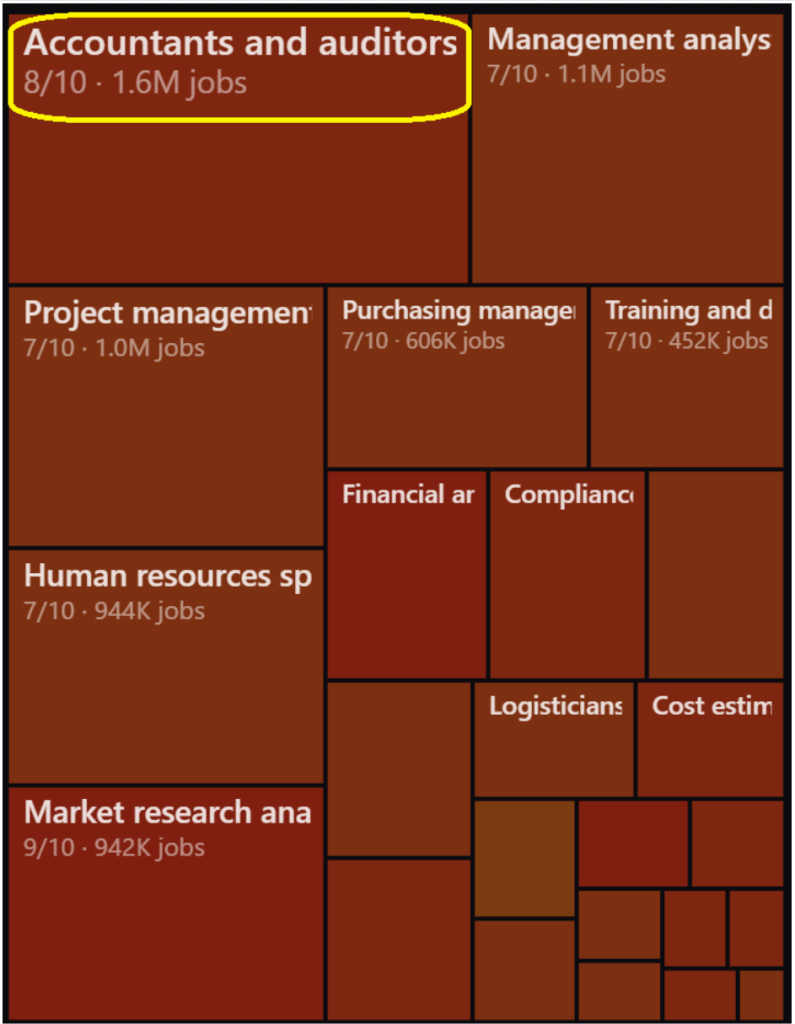
The second came from Andrej Karpathy, OpenAI co-founder, former Tesla AI director, and one of the most credible voices in the field. On a Saturday morning in March he published a heat map scoring 342 U.S. occupations on their exposure to AI automation. Unlike Anthropic, he wasn’t trying to make a statement. He simply had a few hours and found the BLS dataset worth visualizing. Accountants and auditors scored 8 out of 10. The block representing 1.6 million jobs is one of the large and dark sections on the map.
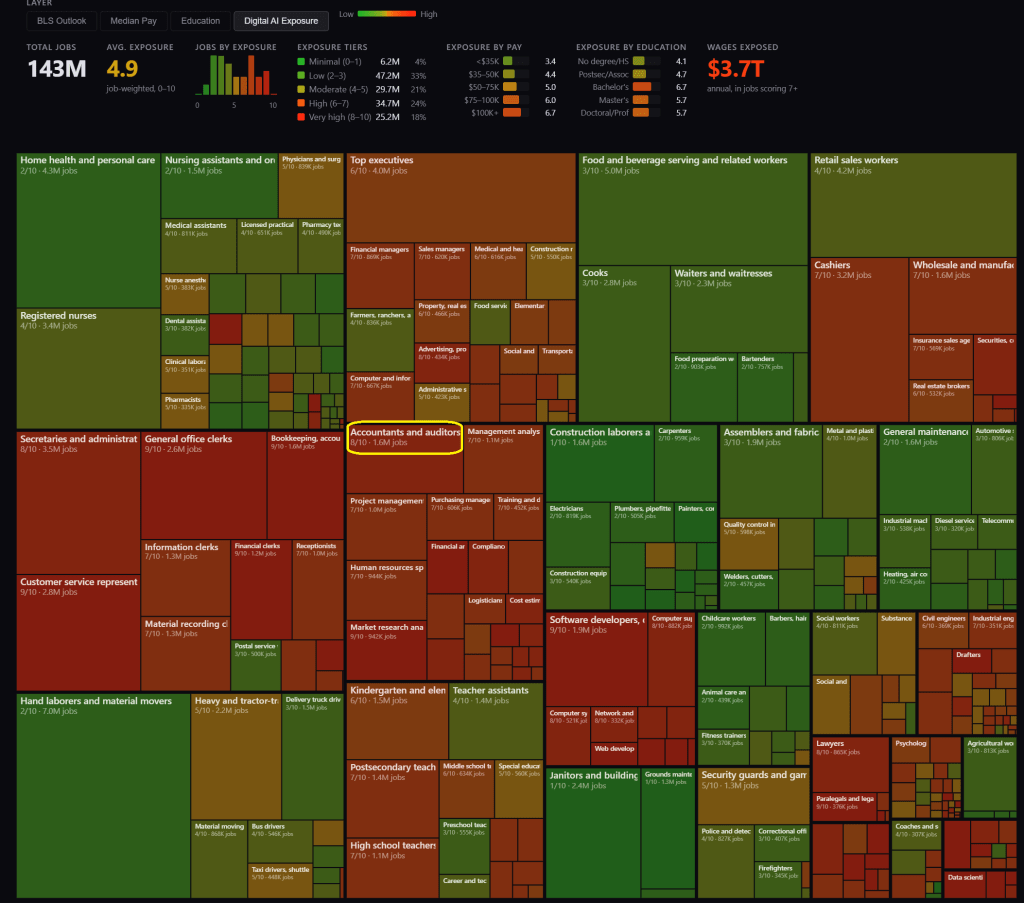
It went viral within hours. By Sunday he had taken the post down, clarifying it was a two-hour experiment, not a forecast. The clarification did not travel nearly as far as the heat map.
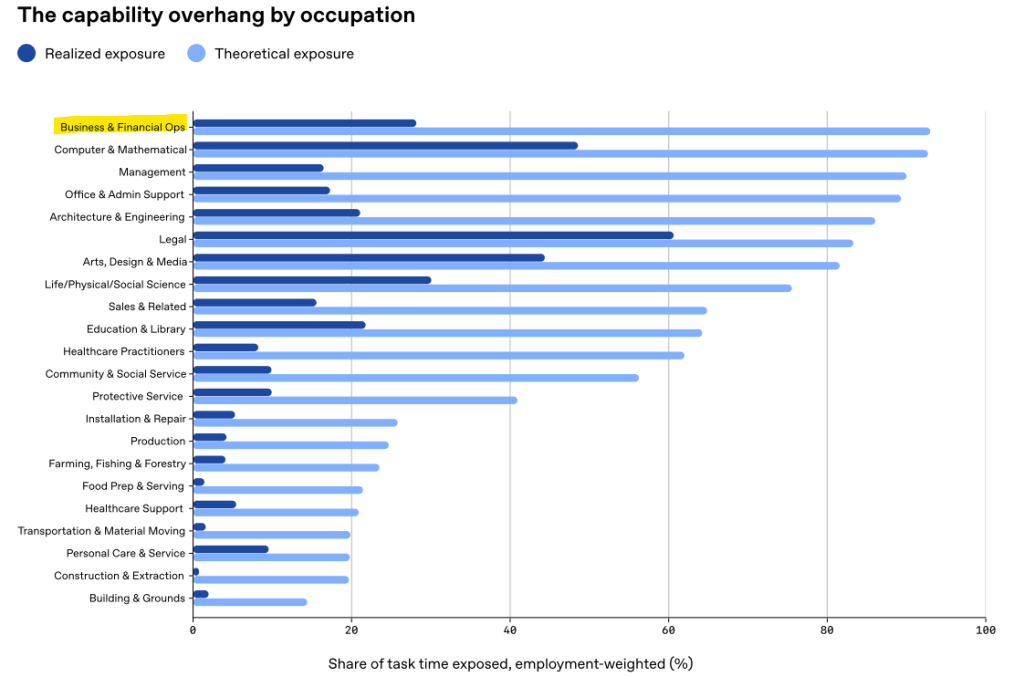
The third report, from OpenAI, explores the transition framework differently while mirroring a very similar graph.
[https://cdn.openai.com/pdf/the-ai-jobs-transition-framework_report.pdf]
These instances wouldn’t have caused such a stir if people weren’t already primed with heightened anxiety around what the future holds. That pre-existing anxiety is not hard to find in the data. Canadian job market optimism dropped 16 points in roughly three years, one of the steepest declines anywhere in the world [link]. While only 18% of frontline employees feel secure in their roles [link].
Great, so now we can add “Anxiety Inflator” to the alternative meanings assigned to “AI”.
And they follow a long line of articles doing exactly the same thing. Identify the disruption. Name the risk. Stop. No consideration of solutions, no path to act on, and no framework to correct course. At the most elementary level of professional competence, you learn to move beyond identifying a problem. You consider what caused it. You evaluate options. You act, observe, and correct. Those kinds of publications are doing the equivalent of walking into your boss’s office and saying “there’s a problem”, and walking out.
This article is an attempt to do the rest of the work.
One Blunt Word Does the Damage
Disruption and destruction are not the same word. “Disruption” is the blunt word doing all the damage.
Grouping every form of change under the single adjective “disruption” completely blurs a spectrum of impacts, making it impossible to interpret. A workflow that gets restructured is disruption. A profession that gets eliminated is destruction. A job description that gets rewritten is disruption. A job market that disappears entirely is destruction. These are not the same thing, and the conflation is where most of the anxiety gets manufactured.
History provides analogues and proves, once again, revisiting it for guidance can offer useful starting points.
When steam-powered manufacturing gave way to electric motors, the furnace stoker shoveling coal to keep the machines running became unnecessary. That role ended. But the manufacturing professionals reorganized around the new energy source and grew. Separately, you can still buy a new buggy whip on Amazon but it’s now a niche market, resized to serve far fewer customers. The distinction matters because a niche or relic market and a disrupted industry are not the same condition.
The agricultural sector is the favourite example for AI-job-pocalypse screeds. Farm labor was genuinely, massively displaced by mechanization, first by the tractor, then by increasingly automated machinery, and now by GPS-guided equipment that runs prescribed paths across fields without a hand on the wheel. The number of people required to produce a given yield dropped dramatically. The labour pool resized however and the work that remained required different skills and judgment, since the tools were now different.
The pattern of disruption reshaping the work rather than ending it repeats across every major technological transition in the last two centuries. The automation of repetitive physical labour, what happened in agriculture and manufacturing, is just starting to arrive in our work too as we automate repetitive key strokes that are better performed by a machine.
That said, the parallels end there and the accounting, auditing, and tax professions are not going to become automated away into a tiny labour pool or a relic market. We’re not in a profession going through the throes of mid-extinction. We are a profession in mid-transformation. That is disruption.
Who is Actually Responsible
There must always be at least one throat to choke.
Surely not the polite way to describe professional accountability, but it is at a minimum one clear reason why we won’t be replaced. So it goes in every regulated profession, every client engagement, every sign-off and tax filing and financial statement, a human being puts their name on the work. That accountability structure will become a more important pillar of the profession as the technology around it grows more capable, precisely because technology cannot be held responsible.
AI can do many things but it cannot be liable.
A model that reviews a thousand transactions and flags anomalies produces output that someone must evaluate and stand behind. The moment an error reaches the boss, a client, a regulator, or at worst a courtroom, the question is “who signed off”. That answer has to be a person.
The disruption is more fundamental than a change in tasks.
The professional is becoming one level removed from work that used to be finger-typed by a person. You may end up fully removed from the raw data used in the preparation. You are now above it, having to evaluate an output you did not produce, generated by a process you did not execute, but must be accountable for the conclusions!
New-Hires – Disrupting a Job Description
It also applies at every level of the profession, including the entry level which is where the existing talent pipeline problems become particularly salient. In the AI-job-pocolypse paradigm, organizations will stop hiring junior staff because AI handles their current tasks. The obvious outcome of this that they stop producing the senior professionals of the future. The logic of total entry-level job elimination requires accepting the eventual collapse of every institution that stopped hiring. That outcome is not plausible, and the premise is rubbish.
What changes at the junior level is the nature of the work, not its existence.
Entry-level roles built around mechanical repetition, data entry, routine reconciliation, tasks requiring effort but not judgment, those specific versions are changing. The roles are moving up a horizon. The junior professional of the near future spends less time executing processes and more time overseeing them, then reviewing AI output and identifying edge cases the model mishandled. In that course, they must develop the judgment that no model yet possesses. The skill that becomes valuable is the ability to identify when the model fails; and they fail in particular ways. The confident wrong answer or the categorization that was technically correct and contextually wrong. Learning to spot those failure modes is the adaptation.
The current “disruption” conversation keeps conflating three distinct things: the task, the role, and the profession.
AI is starting to perform and execute tasks, absorbing them away from humans. Some roles are being restructured around that absorption. And the profession must return to a clear understanding of what its value actually is: the judgment work, the accountability, the professional relationship with an advisor, client or tax authority that the model cannot replicate. That has always been the primary value that we’re being paid for.
You’ve Been Through this Before
Thankfully you can draw comfort in knowing that you’ve been through some significant disruptions before and you’re still here to talk about them.
Leaving Childhood
Think back to adolescence. The physical and emotional transformation of those years happened to you at a pace that you had no control over whether you liked it or not. This happened in ways that impacted your unique person even as everyone around you was going through a version of the same thing. We’re all in this together. Piece of cake right?
Then came the education-to-work transition. You graduated with your degree erroneously thinking you actually knew things. Having filled your mind with facts and knowledge, you then arrived in the real world and quickly discovered that knowing things and doing things are categorically different skills.
“You know nothing John Snow”
– Ygritte (Game of Thrones)
The theoretical frameworks that organized your thinking in school required immediate translation into something that was never covered in the curriculum.
After that came more disruptions. Changing jobs that required you to rebuild your professional identity from scratch in a new environment. Getting promoted from staff to manager; you thought you were already “acting-manager”, but that was a mirage. Moving homes which left the geography of your social world behind and forced you to construct a new one. Relationships formed and ended which reorganized the basic logistics and emotional reality of your daily life.
Children, if you have them, are truly in a category of their own. No one who has not had children can fully understand what it does to your sense of time, priority, identity, and capacity. No one who has had them would trade it away. And regardless of all the internet advice and opinions and guidance from parents and peers, the adaptation had to be experienced – it was different for everyone.
What every one of these transformations shares is that they had been done before. Maybe not by you, but by people you knew and could reach. Your colleagues navigated the shift from education to work before you did. Your parents had children before you did (obviously). Your mentors had changed careers, changed cities, changed the entire shape of their professional lives. The roadmap was imperfect and incomplete, but at least it existed. You could ask someone who had been through it.
This time is different.
No one alive has experienced a global shift in ‘era’. Nomad to agrarian, pre- to post-industrial, and the changes from classical to post-classical societies. Accounts of these disruptions are captured in writing and I’ve suggested earlier that revisiting history can be instructive. But that risks repeating the very gap our earlier university education left un-bridged in preparing us for actually doing things in the workforce.
The anxiety does not come from ignorance about whether change is coming. It comes from the absence of anyone who has been through it and come back to describe what they found. We cannot solve that problem before moving, it is simply the condition we are all working in.
This time is no different.
If I were to hazard a guess, I’d bet those who thrived through era-shifting change got their hands dirty. Literally dirty…sifting through the soil instead of dithering over the merits of planting crops and delaying by endlessly seeking advice from neighbouring tribes. Physically handling and shaping the machines that powered the new industrial workplace instead of taking courses on “steam-engineering”. And so it is with this shift in era.
The way forward is to work directly with the tools on real projects that are directly related to your professional responsibility.
Already In Your Toolbar
The technology and tools aren’t the disruption on their own; the change in process and your behaviours are where the disruption and transformation will really be felt.
For accounting and finance professionals, the transformation is already embedded in the software open on your screen right now. QuickBooks, Excel, your consolidation engine. The AI is being added or is already there. Most people have not looked directly at it yet.
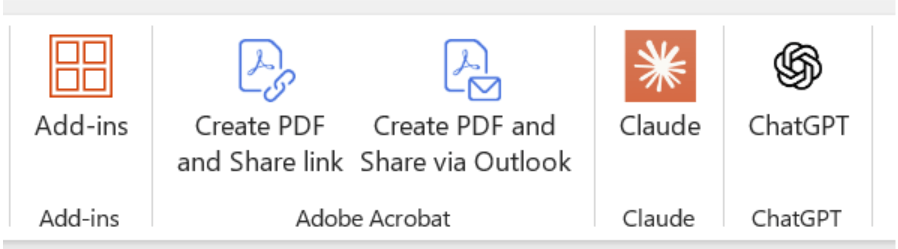
For example, the Excel add-ins are where the shift becomes most visible. Claude, Copilot, and ChatGPT each offer add-ins that embed directly into your workbook environment. They represent the first flavour of agentic AI most accounting professionals will encounter: you interact with the AI in natural language and it proceeds to act on your behalf inside the application. Not generating a document you then paste somewhere.
The range of what this enables is striking, and the gap between what people imagine these tools do and what they actually do is still wide.
Understanding Unfamiliar Work
Ask the add-in to explain an unfamiliar tab and it will tell you what is being calculated, how the formulas relate to each other, and how that tab connects to the rest of the workbook. The mental model you used to build by manually tracing cell references, following formula logic, and reverse-engineering someone else’s work now gets built by asking the right questions and reading the answers. The cognitive work shifts from excavation to evaluation. You are still building the mental model. You are building it faster and with less friction.
On-Demand Technical Lookup
Ask it about CCA Class 43.1 and it looks it up, either drawing on its training data or connecting to current information if the add-in has web access. A question that used to require jumping to Google or the CRA website, finding the relevant schedule, reading the eligibility criteria, and returning to the workbook now gets answered without leaving the tab.
The Review Nobody Had Time For
Ask it to review the formulas across a tab or workbook and it will find what you did not have time to check. I stumbled across <$200K in missed CCA deductions when I was using the Claude add-in to experiment with different presentation formats. My attention was on the format and layout of presenting a new style of CCA schedule; the numbers weren’t my focus. Tying the numbers is the last step to ensure my new approach held together, but as Claude finished the build, they didn’t tie with the original schedule. Claude pointed out the formulas in the original table that didn’t extend to the most recent year’s row.
Now my interest was piqued…apparently research literature on this topic reveals between 88% – 91% of spreadsheets have errors. The larger the workbook, the question shifts from whether an error exists, to how many errors exist.
Surprised by the above finding, I tested more tabs. The agent found $000’s more from cells linking to the wrong columns and rows. The kind of mechanical error that slips through every manual review because the human eye is not optimized for catching these inconsistencies across hundreds of rows.
One Level Removed, Fully Responsible
The add-in is not replacing the professional judgment required to understand what the numbers mean. It is replacing the manual verification work that was always a poor use of that judgment in the first place. The time recovered goes back to the work that actually requires a trained professional to perform it.
This is one of the clearest illustrations of what being one level removed from the work actually feels like in practice. You are not entering the data. You are not tracing the formulas. You are directing the process, evaluating the output, and applying judgment to what the add-in surfaces. The professional relationship with the work has changed. The professional responsibility for the work has not moved an inch.
Adapting In the Rapids
“Resistance is futile.”
— The Borg, Star Trek
I used to coach new hires with a white water kayaking analogy. My team and I were already on the river, working the rapids with the skill that comes from having run them before. The new hire stood on the shoreline. Our job was to coach them from the bank, then guide them in, until they could handle the water on their own. This was a reliable framework because it correctly assumed the experienced people had already run the river.
That assumption no longer holds.
We have all left the river. Nobody has run these particular rapids. The coaching model built on “follow me, I’ve been here” no longer fully applies, and pretending otherwise is its own kind of problem. What replaces it is not a new framework so much as a return to what experienced explorers did when no map existed; they forged ahead and drew the maps in real-time as they experienced them.
That is uncomfortable for any person who’s grown proficient in routinely doing their job.
The direction forward requires project-based learning. Find something specific in your current work like a volume problem your team cannot get ahead of or a recurring task that consumes hours without requiring much judgment, and point the technology at it. This will not solve the whole problem immediately. It aims to build familiarity with how the tools actually behave on work you already understand. This builds comfort from frequent use. The confidence will grow.
What will surprise most professionals is that the disruption does not arrive where they expected it. The technology itself is not the disruptive part. What requires adjustment is what happens after the technology works. This is when a process that used to take your team three days now takes three hours; the workflow around it has to change. This leads to changing expectations. Then this changes the way work is assigned, reviewed, and delivered. Those are behavioral changes, not technical ones, and they land in the middle of professional lives that were organized around the older pace of doing things.
Taking on one process change deliberately, with a specific tool pointed at a specific problem, turns that disruption from something happening to you into something you are authoring. The familiarity it builds with the technology extends outward from there. One process becomes two. One tool becomes several. The comfort that makes everything else possible does not come from reading about what AI can do. It comes from having already made it do something.
ADP’s 2026 workforce research found that employees whose organizations were actively investing in their development were 5.3 times more likely to feel secure in their roles. These weren’t workers whose jobs were protected from AI, rather workers who had been given a path forward.
Point yourself at something specific. Start there.

